

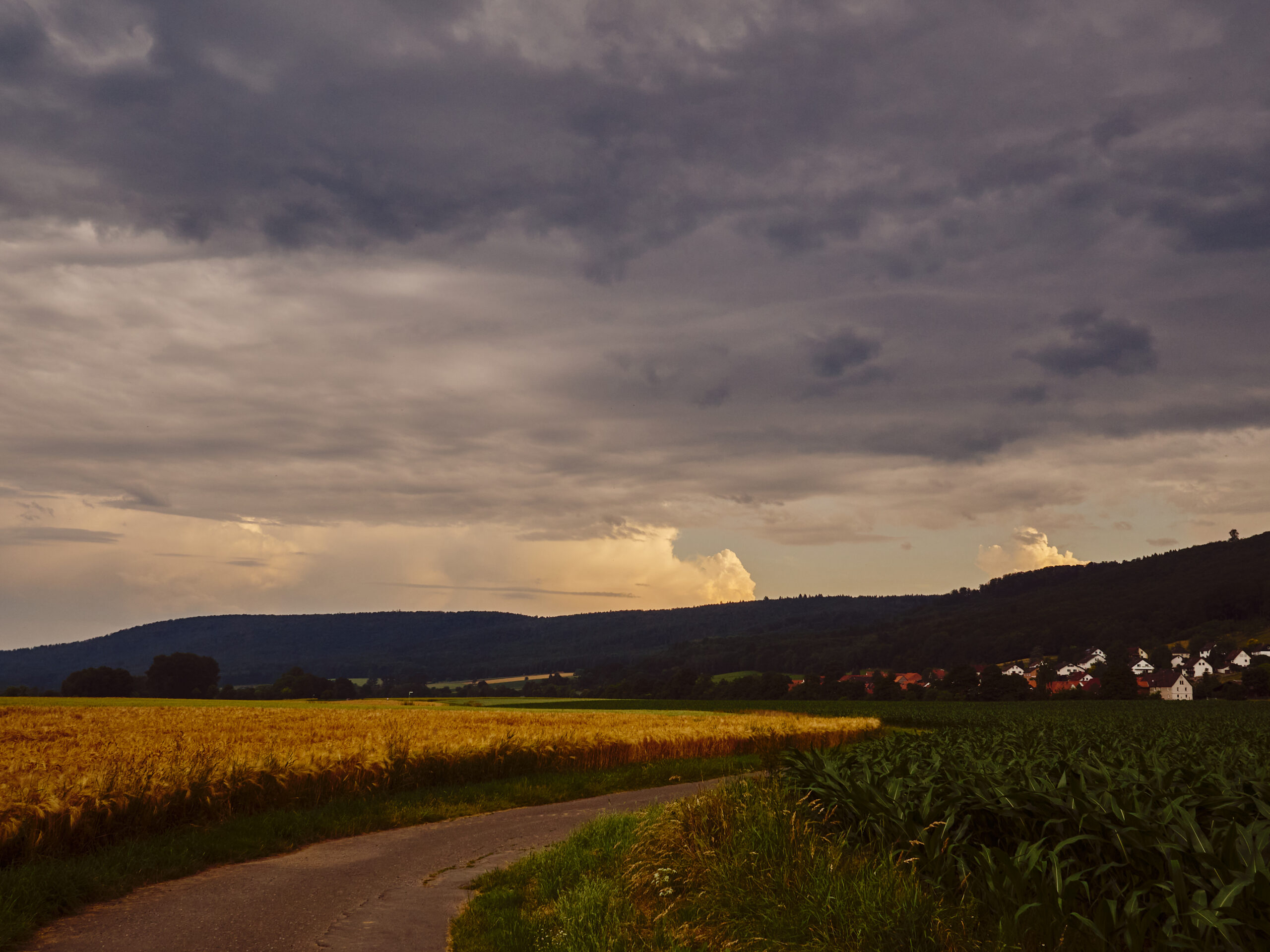
A humid summer evening in a wooden hut at the foot of the Reinhardswald. Clouds have been in the sky all day. Towering clouds, in fact – huge, majestic towers of cloud. But none of it seems to want to come down. Instead, it just gets hotter, even more suffocating.
Then, late in the evening, finally a few scattered raindrops. Buba is lying on the sofa; she looks suspiciously towards the window, her nose twitching anxiously as she sniffs the rain. I look at her; she looks back. Go on, go out, she seems to be saying to me, rain doesn’t mean much to me, but you seem to need it.
I go outside, start running, across the main road, down to the Weser, which has flowed past the little Waldensian village of Gottstreu for millennia, indifferent to people and their achievements and their failures.
I stretch out my arms, I want to feel the rain on my skin – but it doesn’t feel as I’d hoped. It’s so hot; the rain is warm, mixing with my sweat before evaporating. It feels as though the rain is falling backwards.
Niar.
Finally, the rain stops completely. I stand on the banks of the Weser; on the opposite bank, the lights of the restaurant are reflected in the water. I hear the water flowing, the crickets chirping; otherwise, it is quiet. Now and then, in the distance, some jerk and his motorbike.
I don’t yet know that this will be my last summer with Buba in the Weser Valley. I don’t yet know that a smouldering fire will render the hut uninhabitable in two years’ time… and I don’t yet know that all the rain that has refused to fall over the last few days will finally pour down over Gottsbüren and Reinhardshagen in one single night, washing away cars and roads and devastating the two villages.
Had I known all that, I would probably have written a different piece of music that night. But as it was, it became “Niar”, an instrumental about how the rain falls backwards, and how salvation seems so close yet simply won’t come.
Leave a Reply